
Deterministic race-condition testing for anything that talks to PostgreSQL.
PgLoom is a model checker that sits between your service and PostgreSQL as a wire-protocol proxy. It fires concurrent requests at your service, holds every database round trip at a gate, and systematically explores how the transactions can interleave. When an interleaving breaks an invariant (a double spend, a lost update, a negative balance, a deadlock), it prints the exact schedule, explains the root cause, and writes a file that replays the bug deterministically in milliseconds.
No SDK, no code changes, no sleeps: point the service's DATABASE_URL at the
proxy. It works the same for Go, Rust, Python, TypeScript, Java or anything
else that speaks the PostgreSQL v3 protocol.
$ pgloom demo
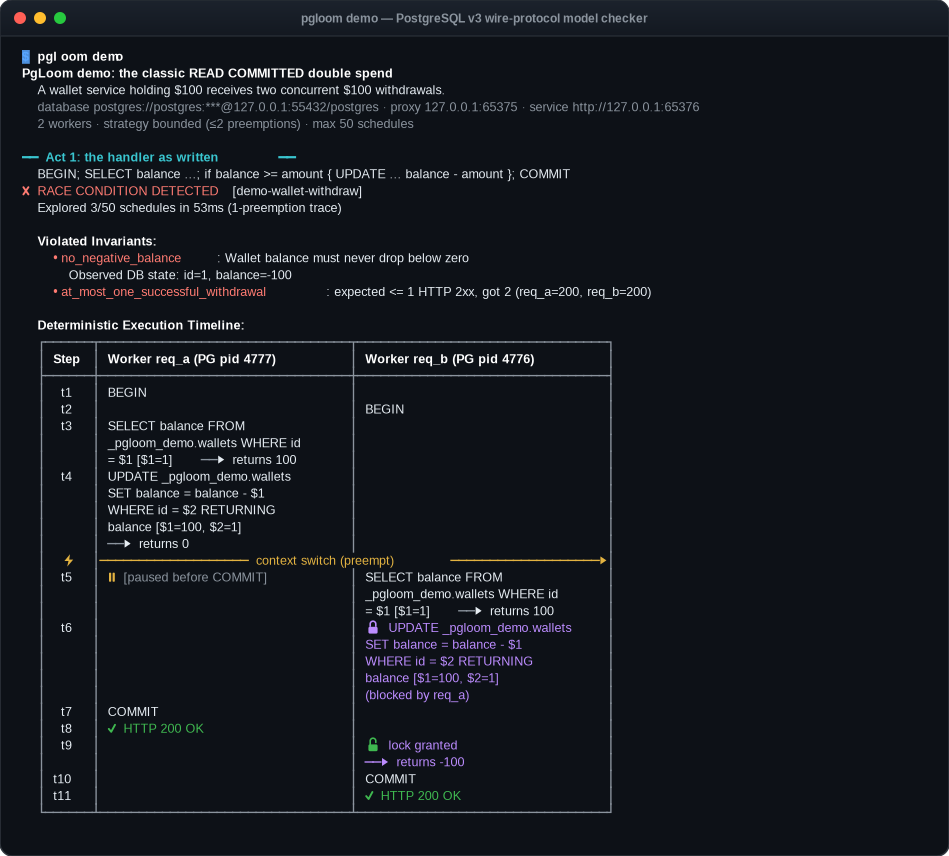
Plain-text transcript
✗ RACE CONDITION DETECTED  [demo-wallet-withdraw]
  Explored 3/50 schedules in 66ms (1-preemption trace)

  Violated Invariants:
    • no_negative_balance: Wallet balance must never drop below zero
      Observed DB state: id=1, balance=-100
    • at_most_one_successful_withdrawal: expected <= 1 HTTP 2xx, got 2 (req_a=200, req_b=200)

  Deterministic Execution Timeline:
  ┌──────┬────────────────────────────────┬────────────────────────────────┐
  │ Step │ Worker req_a (PG pid 205)      │ Worker req_b (PG pid 204)      │
  ├──────┼────────────────────────────────┼────────────────────────────────┤
  │  t1  │ BEGIN                          │                                │
  │  t2  │                                │ BEGIN                          │
  │  t3  │ SELECT balance FROM wallets    │                                │
  │      │ WHERE id = $1 [$1=1]           │                                │
  │      │ ──► returns 100                │                                │
  │  t4  │ UPDATE wallets SET balance =   │                                │
  │      │ balance - $1 WHERE id = $2     │                                │
  │      │ [$1=100, $2=1] ──► UPDATE 1    │                                │
  │  ⚡  │─────────────────── context switch (preempt) ───────────────────►│
  │  t5  │ ⏸ [paused before COMMIT]       │ SELECT balance FROM wallets    │
  │      │                                │ WHERE id = $1 [$1=1]           │
  │      │                                │ ──► returns 100                │
  │  t6  │                                │ 🔒 UPDATE wallets SET balance  │
  │      │                                │ = balance - $1 WHERE id = $2   │
  │      │                                │ [$1=100, $2=1]                 │
  │      │                                │ (blocked by req_a)             │
  │  t7  │ COMMIT                         │                                │
  │  t8  │ ✓ HTTP 200 OK                  │                                │
  │  t9  │                                │ 🔓 lock granted ──► UPDATE 1   │
  │ t10  │                                │ COMMIT                         │
  │ t11  │                                │ ✓ HTTP 200 OK                  │
  └──────┴────────────────────────────────┴────────────────────────────────┘

  Root Cause & Recommended Remediation (Fix Advisor):
    Pattern: Unprotected Check-Then-Act under READ COMMITTED
    Fix Option A (Pessimistic Lock):
      SELECT balance FROM wallets WHERE id = $1 FOR NO KEY UPDATE;
    Fix Option B (Atomic Guarded Update):
      UPDATE wallets SET balance = balance - $1 WHERE id = $2 AND balance >= $1;
      -- and verify rows_affected == 1 before reporting success.

  Replay deterministically:
    $ pgloom replay .pgloom-repro.json

  Concurrency review for ledgers and payment systems: voskan1989@gmail.com
The demo then patches the handler with FOR NO KEY UPDATE, re-explores every
interleaving, parking the second transaction on the row lock instead of
hanging, and reports PASS. It needs no setup: it uses --upstream,
DATABASE_URL, a server on localhost:5432, or starts a throwaway
postgres:17-alpine container.
Most concurrency bugs in database-backed services are not data races in the
application's memory. They are interleavings of transactions: two requests
read the same balance under READ COMMITTED, both decide the withdrawal is
fine, both commit. Unit tests run requests one at a time; load tests hit the
window by luck and cannot reproduce it. Thread schedulers such as
loom explore in-process interleavings but
cannot see a SQL transaction.
PgLoom controls the one place every request must pass through: the database connection. Interleaving at the granularity of whole protocol round trips is small enough to explore exhaustively for two or three requests and exactly fine-grained enough to expose check-then-act races, lost updates, write skew, phantom inserts and lock-order deadlocks.
Prebuilt static binaries for Linux (x86_64, arm64) and macOS (Intel, Apple
silicon) are attached to every release.
Replace the target with aarch64-unknown-linux-musl, x86_64-apple-darwin or
aarch64-apple-darwin as needed:
$ curl -sSfL https://github.com/Voskan/pgloom/releases/latest/download/pgloom-x86_64-unknown-linux-musl.tar.gz | tar -xz
$ ./pgloom-x86_64-unknown-linux-musl/pgloom demo
Or install from crates.io with Rust 1.89 or newer:
$ cargo install pgloom --lockedPostgreSQL 12 or newer is required (CI runs every release against 12 through 17). The role PgLoom connects as needs
CREATE on the database (for its snapshot schema) and must be able to see and
signal the service's backends: the same role, a superuser, or membership in
pg_read_all_stats and pg_signal_backend. pgloom doctor checks all of it.
$ pgloom init                 # writes a commented pgloom.yaml
$ pgloom run                  # explores schedules; exit code 1 on a violation
$ pgloom replay               # re-runs the recorded failing schedule
A scenario describes the database, the service and the concurrent requests:
version: 1
name: "wallet-double-spend-withdraw"

database:
  upstream: "${PGLOOM_UPSTREAM_URL:-postgres://postgres:postgres@127.0.0.1:5432/app_test}"
  proxy_listen: "127.0.0.1:15432"      # point the service's DATABASE_URL here
  setup_sql: |
    CREATE TABLE IF NOT EXISTS wallets (id INT PRIMARY KEY, balance BIGINT NOT NULL);
    TRUNCATE wallets;
    INSERT INTO wallets VALUES (1, 100);

target:                                 # optional: PgLoom starts and stops it
  command: "go run ./cmd/api"
  env:
    DATABASE_URL: "postgres://postgres:postgres@127.0.0.1:15432/app_test?sslmode=disable"
  ready_http: "http://127.0.0.1:8080/healthz"

workers:
  - id: "req_a"
    http: { method: POST, url: "http://127.0.0.1:8080/withdraw", body: '{"wallet_id": 1, "amount": 100}' }
  - id: "req_b"
    http: { method: POST, url: "http://127.0.0.1:8080/withdraw", body: '{"wallet_id": 1, "amount": 100}' }

invariants:
  sql:
    - name: "no_negative_balance"
      assert_true: "SELECT COALESCE(MIN(balance), 0) >= 0 FROM wallets"
      diagnostic_query: "SELECT id, balance FROM wallets"
  responses:
    - name: "at_most_one_successful_withdrawal"
      max_2xx_count: 1
    - name: "reported_balance_is_consistent"
      json:
        - { pointer: "/balance", min: 0 }
      distinct: "/balance"
  fail_on_deadlock: true
Workers can also be plain SQL scripts sent through the proxy (sql: [...])
or shell commands (exec: { command: ... }, with DATABASE_URL pointing at
the proxy).
PgLoom prepares the database in this order: setup_sql, then the target is
started and becomes ready, then seed_sql, and only then is the reference
snapshot taken and the catalog read. Services that run their migrations on
startup therefore work unchanged: put the schema in the migrations and the
fixture rows in seed_sql. Working directories (target.workdir,
exec.workdir) are relative to the scenario file, which is also the default,
so pgloom run examples/go-wallet/pgloom.yaml works from anywhere.
Response invariants matter: a lost update can leave a perfectly plausible
balance while both callers were told their withdrawal succeeded. Besides
counting successes (max_2xx_count, min_2xx_count, allowed_statuses),
they can check JSON response bodies:
| Key | Meaning |
|---|---|
json: [{ pointer, ... }] |
Per response: exists: true|false, equals: <value>, one_of: [...], min / max (inclusive, numeric). Pointers follow RFC 6901. |
distinct: <pointer> |
The value must differ between responses, e.g. two debits cannot both report the same new balance. |
apply_to: success|all |
Body checks look at 2xx responses (default) or every response. |
workers: [ids] |
Restrict body checks to these HTTP workers. |
See examples/go-wallet for a Go service using a
pgx connection pool, examples/python-wallet
for a Python lost update caught only by its responses, and
examples/sql-transfer for a deadlock found
without any service at all.
 workers ──HTTP──► your service ──pgwire──► PgLoom proxy ──pgwire──► PostgreSQL
                                               │    ▲
                                       turn ready │    │ grant / release
                                               ▼    │
                                          coordinator ◄── schedule explorer
                                               │
                         pg_blocking_pids(), snapshot restore, invariants
- Wire turns. The proxy groups client messages into turns: a simple
query, an extended-protocol pipeline up to
Sync, or a portal batch up toExecute+Flush. Prepared statements are tracked per connection, so aBindwithoutParsestill reports its SQL and parameters. Driver chatter (SET,SHOW, catalog lookups) passes through unscheduled. - One decision per turn. Exactly one worker runs application code at a time; every other worker is held at the gate, parked on a lock, or waiting for its held response. This makes the mapping from connections to workers deterministic even behind connection pools.
- Park on lock, never hang. A granted turn that does not finish within
lock_probe_ms(2 ms by default) is checked withpg_blocking_pids(). If another worker holds the lock, the waiter is parked and the holder is scheduled. A cycle in the wait-for graph is a proven deadlock, reported before PostgreSQL's owndeadlock_timeoutwould fire. - Real commits. Transactions commit for real, so
READ COMMITTEDvisibility is exactly what production sees. Between schedules, only the tables that were written are restored from unlogged snapshot copies in the_pgloom_snapschema, in one short transaction. - Systematic exploration. The default
boundedstrategy is iterative preemption bounding (as in Microsoft's CHESS): all schedules with zero preemptions, then one, then two. Most races need a single preemption, so failures are found early and with the simplest trace.exhaustiveand seededrandomare also available. All choices are made over ordered collections, so the same scenario explores the same schedules in the same order every time. - Partial-order reduction. With
strategy: exhaustive, PgLoom skips schedules that only reorder independent steps (reduction: dpor, the default;noneturns it off). Each turn's footprint (tables read and written, row locks, sequences, foreign keys, partitions, triggers, row-level security policies, volatile functions) comes from its SQL and the system catalog; two turns conflict when one writes what the other touches, and anything opaque conflicts with everything. Source-DPOR with sleep sets then runs at least one schedule from every class of equivalent interleavings, so the verdict matches plainexhaustivein a fraction of the schedules. It is not combined with preemption bounding, whose budget is not preserved by reordering. The database must be the only state the workers share: clear any cross-schedule in-memory cache viatarget.reset_http(POST), and usereduction: nonewhen workers share mutable in-memory state within a schedule. - Shrinking and replay. A failing schedule is minimized before it is
reported, then saved with the scenario it came from in
.pgloom-repro.json.pgloom replayre-executes exactly that schedule; if the service has since been fixed, the replay adapts and reportsNOT REPRODUCED.
| Command | Purpose |
|---|---|
pgloom run [pgloom.yaml] |
Explore schedules and report violations. --strategy, --reduction none|dpor, --max-preemptions, --max-schedules, --seed, --find-all (one report per distinct set of violated invariants), --no-shrink, --repro-out, --format pretty|json. |
pgloom replay [.pgloom-repro.json] |
Re-execute a recorded failing schedule. |
pgloom demo |
The self-contained two-act showcase. |
pgloom init |
Write a commented starter scenario. |
pgloom doctor |
Check connectivity, permissions, latency and the proxy port. |
Global flags: --color auto|always|never, --quiet, -v/-vv.
| Code | Meaning |
|---|---|
0 |
Every explored schedule satisfied every invariant. |
1 |
A violation or deadlock was found; a repro file was written. |
2 |
Invalid scenario, unreachable database, the service did not start or exited, or no SQL from the workers reached the proxy (the service bypassed it). |
3 |
Internal error, such as a step that neither completed nor waited on a lock. |
130 |
Interrupted with Ctrl+C. The first press finishes the current schedule and restores the database; a second one aborts at once. |
A GitHub Actions job with a PostgreSQL service container. PgLoom starts the
service itself through target.command, so build it first:
pgloom:
  runs-on: ubuntu-latest
  services:
    postgres:
      image: postgres:17-alpine
      env:
        POSTGRES_PASSWORD: postgres
      ports: ["5432:5432"]
      options: >-
        --health-cmd "pg_isready -U postgres"
        --health-interval 2s --health-timeout 5s --health-retries 20
  env:
    PGLOOM_UPSTREAM_URL: postgres://postgres:postgres@127.0.0.1:5432/postgres
  steps:
    - uses: actions/checkout@v4
    - name: Install PgLoom
      run: |
        curl -sSfL https://github.com/Voskan/pgloom/releases/latest/download/pgloom-x86_64-unknown-linux-musl.tar.gz \
          | tar -xz -C "$RUNNER_TEMP"
        echo "$RUNNER_TEMP/pgloom-x86_64-unknown-linux-musl" >> "$GITHUB_PATH"
    - run: go build -o app .        # or however the service is built
    - run: pgloom run --quiet --format json > pgloom-report.json
    - uses: actions/upload-artifact@v4
      if: failure()
      with:
        name: pgloom-repro
        path: |
          .pgloom-repro.json
          pgloom-report.json
--quiet keeps the log to the verdict and the violated invariants; the full
timeline and Fix Advisor are in the JSON report, and pgloom replay .pgloom-repro.json replays the failing schedule locally. Pin a version with
releases/download/vX.Y.Z/pgloom-vX.Y.Z-<target>.tar.gz when the build must
be reproducible.
- Scenarios are meant for two or three concurrent requests; the number of interleavings grows exponentially beyond that.
- Every worker needs its own database connection: connection pools must allow at least as many connections as there are workers.
- TLS between the service and the proxy is not supported (the hop is local;
use
sslmode=disable). Unix-domain sockets are not supported. - Nondeterminism in the service itself (randomized retries, timers, background jobs touching the same tables) is reported rather than explored.
- A turn is indivisible: an extended-protocol pipeline up to
Sync, or a simple query holding several statements, runs as one step. Interleavings between turns are explored, interleavings inside a single batch are not. Check-then-act races are unaffected, since the application cannot branch in the middle of a batch it has already sent. - Linux and macOS only. The target service and
execworkers are launched throughsh; Windows is not supported.
| Crate | Responsibility |
|---|---|
pgloom-wire |
PostgreSQL v3 framing, turn assembly, SQL classification, the gating proxy. |
pgloom-pgctrl |
Control connection: lock inspection, cancellation, snapshots, SQL invariants. |
pgloom-engine |
Schedule explorer, coordinator, wait-for graph, shrinking. |
pgloom-driver |
pgloom.yaml, HTTP / SQL / exec workers, response invariants. |
pgloom-report |
Timeline renderer, Fix Advisor, JSON output, repro files. |
pgloom-cli |
The pgloom binary (package pgloom). |
Running the full test-suite needs a PostgreSQL server; tests that need one are skipped when it is unreachable:
$ docker run -d --rm -p 55432:5432 -e POSTGRES_PASSWORD=postgres postgres:17-alpine
$ PGLOOM_TEST_DATABASE_URL=postgres://postgres:postgres@127.0.0.1:55432/postgres cargo test --workspace --all-featuresPgLoom grew out of reviewing ledgers, wallets and billing systems for exactly these failure modes. If you run money-moving code on PostgreSQL and want a second pair of eyes on its concurrency design, write to voskan1989@gmail.com. Findings stay private.
Apache-2.0. See LICENSE.